
VMware Cloud Foundation (VCF) has become the foundation for modern private cloud, helping organizations modernize infrastructure, improve operational efficiency, strengthen resilience, and create a scalable platform for enterprise AI.
As private cloud becomes a strategic business platform, infrastructure metrics alone are no longer enough. Today’s executives need complete visibility to know what they own, optimize capacity to drive workload density, and connect every dollar of spend to true value realization.
ValueOps extends VCF with Business & Financial Intelligence, bridging the gap between platform operations and business strategy. By connecting strategy, infrastructure, financials, and outcomes through a unified digital thread, infrastructure and FinOps teams can:
Know What You Own: Gain complete, real-time visibility across your entire hybrid VCF footprint—eliminating operational blind spots and untracked assets.
Drive Density: Optimize compute, storage, and GPU utilization to squeeze maximum performance out of existing hardware before buying more expensive AI infrastructure.
Spend to Value Realization: Shift from static cost reporting to proactive financial governance—demonstrating exactly how VCF investments fuel business growth and AI innovation.
Learn how organizations are closing the "Value Translation Gap" and transforming private cloud investments into measurable business outcomes.
Read the IDC ReportTo successfully steer and align technology, infrastructure, and financial strategy at scale, enterprise IT and Finance leaders rely on three core pillars of Advanced Infrastructure Portfolio Management:



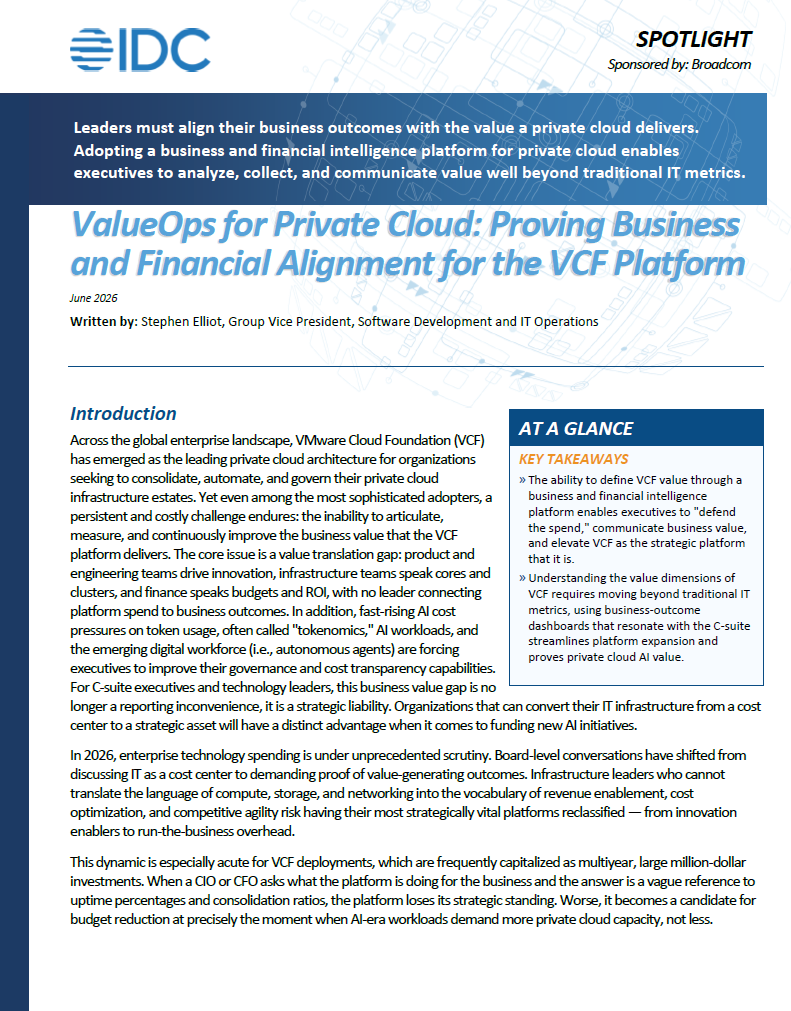
C-suite scrutiny on technology budgets is at an all-time high. Infrastructure leaders face a defining inflection point: you can no longer report on "cores and clusters". Instead, you must translate VMware Cloud Foundation (VCF) investments into business outcomes, revenue enablement, and AI cost control.
Read this IDC Spotlight Report by Stephen Elliot (Group VP, Software Development & IT Operations) to learn how leading enterprises are closing the "Value Translation Gap," taming public cloud "tokenomics," and turning VCF into a self-funding innovation engine.
Close the Value Translation Gap: Align product, infrastructure, and finance teams around a unified digital thread that maps VCF spend directly to corporate OKRs.
Master Private AI & Tokenomics: Compare public cloud LLM "token taxes" against private VCF inference to drastically lower the unit cost of AI workloads.

VCF Advanced Infrastructure Portfolio Management, powered by ValueOps and VCF, is designed to steer, govern, and align technology, infrastructure, and financial strategy. It acts as a single pane of glass across your entire hybrid estate, including private cloud, public cloud, and on-premise assets, to help enterprise leaders transform their infrastructure from an unpredictable expense into a forecastable strategic asset for the AI era.
VCF shifts organizations from reactive cost management to proactive, data-driven forecasting. By continuously tracking planned versus actual savings, it eliminates the guesswork associated with historical cloud billing. This dynamic tracking provides CFOs and IT leaders with traceable, sub-ledger evidence to ensure their modernization efforts deliver guaranteed financial outcomes.
Migrating AI workloads to a Private Cloud environment using VCF can yield up to a 60% Total Cost of Ownership (TCO) advantage over public cloud alternatives. VCF Advanced IPM is the engine to visualize and prove TCO. This approach allows enterprises to escape the variable "token tax" of public Large Language Models (LLMs) and shift their spend from variable cloud rentals into appreciating corporate assets.
ValueOps empowers you to establish transparent financial guardrails that govern the economics of your AI investments. Instead of dealing with unmanaged AI sprawl, the platform creates the precise visibility needed to attribute every single dollar of AI infrastructure directly back to the business unit consuming it.
The "Digital Thread" is a comprehensive mapping hierarchy that connects broad corporate strategy down to specific initiatives, applications, and physical infrastructure. By establishing this thread, organizations ensure that every IT dollar spent is directly mapped to tangible business goals, aligning IT execution with financial reality.
By auditing your application inventory and modeling the cost of change, VCF Advanced IPM helps identify redundant applications and infrastructure waste. You can monetize this operational waste from rationalization and migrations to self-fund your Private AI expansion, effectively funding the future without constantly asking the board for net-new budget.
No. ValueOps establishes a single pane of glass across your entire hybrid IT estate. This includes on-premise physical environments, private clouds, public clouds, and SaaS applications. This unified visibility allows you to conquer infrastructure sprawl and manage complex hardware lifecycles regardless of where the workloads live.
This platform is built specifically for enterprise IT and Finance leaders. It empowers Infrastructure Leaders to move beyond manual spreadsheets and unpredictable billing, helps CIOs align technology infrastructure with AI-driven business needs , and provides CFOs with the traceable, sub-ledger evidence needed to transform IT from a perceived cost center into a forecastable strategic asset.
The core difference lies in moving from reactive, manual tracking to proactive financial and business intelligence.
Classic IPM: Relies heavily on reactive cost management and leaves teams trapped in the "Data Dungeon," drowning in manual spreadsheets while guessing on dependencies. It is defined by siloed execution, rigid waterfall planning, and linear outputs, making it incredibly difficult to validate cloud savings or manage a modern, hybrid portfolio.
Advanced IPM: Powered by ValueOps and VCF, Advanced IPM is not just another tool, but a comprehensive platform that acts as a single pane of glass across your entire hybrid estate—including private cloud, public cloud, and on-premise assets—to provide proactive, data-driven forecasting. By establishing a "Digital Thread," it maps your broad corporate strategy directly down to physical infrastructure, ensuring every IT dollar is aligned with tangible business goals.
Ultimately, VCF Advanced IPM changes the executive conversation from "how much does it cost?" to "how much tangible business value is our infrastructure driving?"