Outcome Assurance

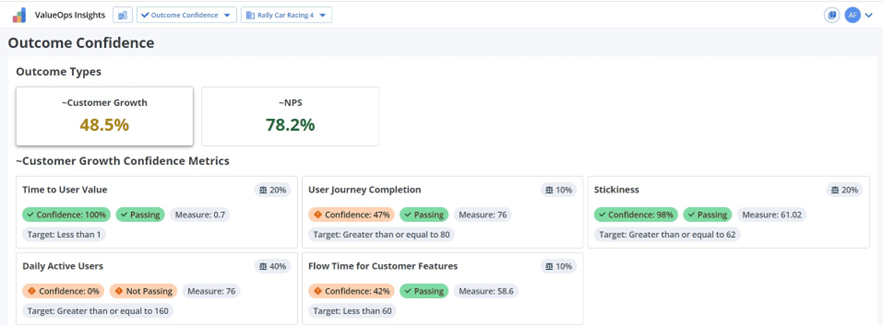
Leaders are no longer measured by activity, they’re accountable for outcomes. Many leaders are making million-dollar decisions without knowing if investments will deliver results. Data is fragmented, insights arrive too late, and teams move faster without clarity on impact.
Outcome Assurance changes that. Instead of tracking outputs after the fact, ValueOps Insights enables leaders to predict and influence outcomes before they’re at risk. By connecting strategy, delivery, and value realization into a single, trusted view, leaders gain real-time visibility into whether investments are on track.
Instead of asking, “Did we hit the target?” you can answer, “Will we hit the target?”—and act in time to influence it.
For example, if customer growth is the goal, you can identify the leading indicators that matter, track progress continuously, and model “what-if” scenarios to course-correct early.
This approach connects strategy, funding, and execution into a single view. The result is confidence—confidence that decisions are grounded in data, risks are visible early, and every investment is driving measurable business impact.
Intelligent Indicators
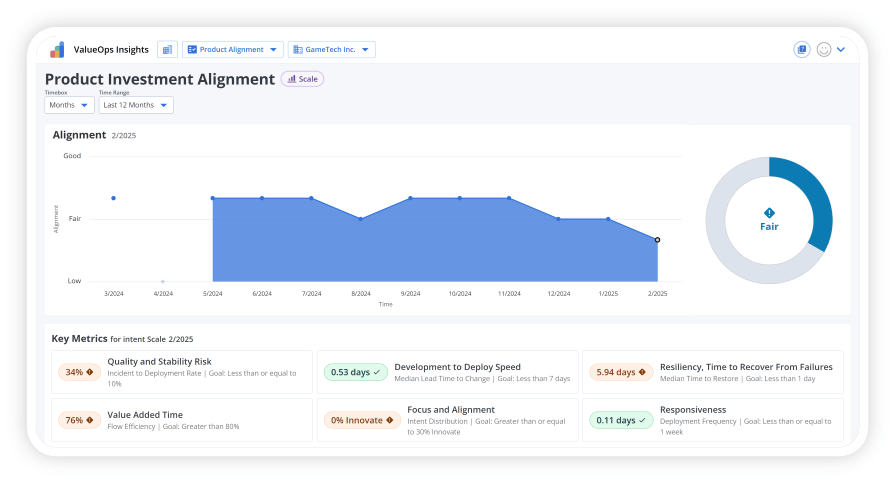
Not all metrics are created equal. Intelligent indicators from ValueOps Insights help leaders focus on the signals that truly predict success, so you can act before outcomes are at risk. Instead of tracking lagging KPIs like revenue after the fact, you define and monitor leading indicators that influence those results.
For example, to ensure faster product adoption, you might track early usage patterns, engagement rates, or time-to-first-value. ValueOps Insights helps you identify which indicators matter most, set meaningful targets, and understand their lead time relative to your desired outcome.
By aligning these indicators to strategic goals, leaders gain a predictive view of performance, turning data into foresight. This allows organizations to move beyond guesswork and manage outcomes with precision, ensuring every decision is grounded in what will actually drive results.
Adaptive Decisions
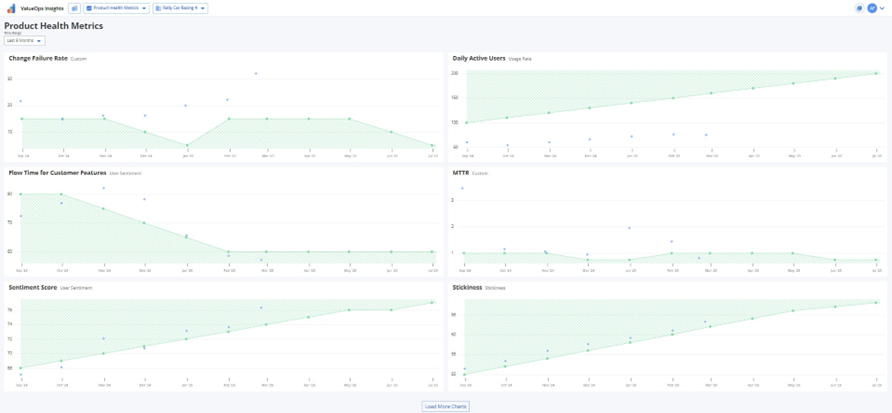
In an enterprise environment, the ability to act early is the difference between hitting targets and missing them. Adaptive Decisions enable leaders to respond to real-time insights—adjusting investments, priorities, and execution before small issues become costly risks.
For example, if early indicators show declining customer engagement, teams can reallocate resources, refine product direction, or shift funding to higher-impact initiatives. Instead of waiting for quarterly results, decisions are made continuously—guided by live data and predictive signals.
Leaders can also proactively model “what-if” scenarios to understand the potential impact of changes before they happen—testing decisions, evaluating trade-offs, and reducing risk before committing resources.
ValueOps Insights provides the visibility and context to act with confidence, connecting execution changes directly to expected business outcomes. The result is a more agile, responsive organization that continuously optimizes performance and delivers measurable results.
Leaders are no longer measured by activity, they’re accountable for outcomes. Many leaders are making million-dollar decisions without knowing if investments will deliver results. Data is fragmented, insights arrive too late, and teams move faster without clarity on impact.
Outcome Assurance changes that. Instead of tracking outputs after the fact, ValueOps Insights enables leaders to predict and influence outcomes before they’re at risk. By connecting strategy, delivery, and value realization into a single, trusted view, leaders gain real-time visibility into whether investments are on track.
Instead of asking, “Did we hit the target?” you can answer, “Will we hit the target?”—and act in time to influence it.
For example, if customer growth is the goal, you can identify the leading indicators that matter, track progress continuously, and model “what-if” scenarios to course-correct early.
This approach connects strategy, funding, and execution into a single view. The result is confidence—confidence that decisions are grounded in data, risks are visible early, and every investment is driving measurable business impact.
Not all metrics are created equal. Intelligent indicators from ValueOps Insights help leaders focus on the signals that truly predict success, so you can act before outcomes are at risk. Instead of tracking lagging KPIs like revenue after the fact, you define and monitor leading indicators that influence those results.
For example, to ensure faster product adoption, you might track early usage patterns, engagement rates, or time-to-first-value. ValueOps Insights helps you identify which indicators matter most, set meaningful targets, and understand their lead time relative to your desired outcome.
By aligning these indicators to strategic goals, leaders gain a predictive view of performance, turning data into foresight. This allows organizations to move beyond guesswork and manage outcomes with precision, ensuring every decision is grounded in what will actually drive results.
In an enterprise environment, the ability to act early is the difference between hitting targets and missing them. Adaptive Decisions enable leaders to respond to real-time insights—adjusting investments, priorities, and execution before small issues become costly risks.
For example, if early indicators show declining customer engagement, teams can reallocate resources, refine product direction, or shift funding to higher-impact initiatives. Instead of waiting for quarterly results, decisions are made continuously—guided by live data and predictive signals.
Leaders can also proactively model “what-if” scenarios to understand the potential impact of changes before they happen—testing decisions, evaluating trade-offs, and reducing risk before committing resources.
ValueOps Insights provides the visibility and context to act with confidence, connecting execution changes directly to expected business outcomes. The result is a more agile, responsive organization that continuously optimizes performance and delivers measurable results.

It’s not enough to rely on gut instinct or the loudest internal voice when prioritizing features. Product leaders need hard data—customer adoption, NPS impact, revenue influence—to make informed decisions. Insights connects delivery metrics with real-world business outcomes, helping teams shift from guesswork to evidence-based prioritization so they can focus on what truly drives growth.
In most organizations, understanding business impact requires days of stitching together disparate data across multiple systems, leading to delays and blind spots. Insights eliminates this friction, providing real-time, actionable scores on product performance that directly align with business goals. With this visibility, product leaders can make proactive, data-driven decisions—without waiting for quarterly reports or time-consuming manual analysis.

Slow release cycles don’t just frustrate teams—they delay customer value and increase competitive risk. The problem often lies in hidden bottlenecks scattered across development, testing, and deployment, making it difficult to pinpoint the true cause of delays. These roadblocks typically appear as incremental inefficiencies across different tools and teams, making them seem isolated until they are pulled together into a single view.
Insights connects the dots across the product lifecycle, surfacing inefficiencies in real time so teams can see the full picture. By providing actionable intelligence on where work is slowing down, teams can proactively remove roadblocks, streamline workflows, and accelerate time-to-market—without sacrificing quality.

Shipping features isn’t the goal—delivering measurable customer impact is. Too many product teams equate success with release velocity, assuming that more deployments automatically translate to business value. But without visibility into engagement, retention, and revenue impact, teams risk focusing on output over outcomes—pushing features that don’t move the needle.
Insights bridges this gap by connecting product execution to real-world business impact. It tracks adoption trends, customer sentiment (NPS), and financial outcomes in real time, making it clear which releases drive value and which miss the mark. By eliminating the guesswork, teams can continuously refine their roadmap, prioritize high-impact work, and ensure every product decision contributes to measurable business success.

Not all products a company develops are created (or invested in) equally. Some products are deemed innovative, requiring a higher priority and greater investment to push the company forward, while others are essential for sustaining the business. Without clarity on these distinctions, it’s easy to misallocate resources or misalign teams.
Insights ensures that product leaders and executives can see, in real-time, exactly where investments are going—whether it’s sustaining existing products or accelerating innovation. Through its business alignment metrics, Insights connects resource allocation directly to business goals, showing how well teams are executing against strategic priorities.
Rather than relying on flow charts, burndown metrics, or capacity reports—which don’t provide actionable insights for C-level executives—Insights delivers a single, unified dashboard that tells the full story. If investments are misaligned, leaders can instantly drill down to see what needs attention, ensuring they stay on track to meet business objectives and maximize value.

Value realization is the process of ensuring that business investments—whether in technology, products, or initiatives—actually deliver measurable outcomes. It goes beyond tracking delivery or completion to answering a critical question: Did this investment create the intended business impact?
In practice, value realization connects strategy, funding, and execution to outcomes like revenue growth, customer adoption, or operational efficiency. It requires visibility into both leading indicators and final results, so organizations can not only measure success but actively manage toward it.
Without value realization, organizations risk delivering work that is completed on time and on budget—but fails to move the business forward.
Value realization in SPM is the ability to connect strategic investments to measurable business outcomes—such as revenue growth, customer retention, or operational efficiency. It goes beyond tracking project completion to understanding whether the work delivered actually creates impact. By aligning strategy, funding, and execution, organizations gain visibility into what is driving value—and what isn’t.
Many organizations struggle because their data is fragmented across systems, and insights arrive too late to influence decisions. Teams often measure activity—like features delivered or velocity—instead of outcomes. Without a unified view of strategy, delivery, and results, it becomes difficult to determine whether investments are truly delivering ROI or simply increasing output without impact.
Leading indicators provide early signals that influence future outcomes, allowing organizations to anticipate performance before results are finalized. Instead of relying on lagging metrics like revenue, leaders can monitor factors such as engagement, adoption, or flow efficiency. This enables earlier intervention, better forecasting, and more confident decision-making tied directly to business goals.
Adaptive decision-making means continuously adjusting priorities, funding, and execution based on real-time insights. Rather than waiting for periodic reviews, organizations respond to emerging risks and opportunities as they happen. This approach allows leaders to reallocate resources, stop low-value work, and double down on high-impact initiatives—improving overall portfolio performance.
To shift from reactive to proactive management, organizations must integrate data across strategy, delivery, and value metrics into a single, trusted view. This enables continuous monitoring, predictive insights, and scenario modeling. With this foundation, leaders can anticipate risks, test decisions before committing resources, and take action early, ensuring outcomes are achieved, not just reported.

ValueOps AI Tokenomics integrates capabilities for managing cost, ensuring governance, and maximizing value. Dive into the solution brief below to discover how you can transform AI into a highly...

Learn how ValueOps with outcome intelligence helps enterprise leaders ensure they achieve the massive 564% ROI promised by VMware Cloud Foundation.

Broadcom ValueOps joins the Tokenomics Foundation as a founding member, helping enterprises measure AI value and track token consumption back to business ROI.

Don’t navigate using the rearview mirror. Learn how ValueOps Insights enables leaders to forecast risks, course correct, and achieve strategic outcomes.

Discover how ValueOps Insights is like Waze for your business. Use leading indicators to boost digital transformation outcomes.

Businesses miss key targets because issues only get discovered when it’s too late to course correct. Predict outcomes and act early with ValueOps Insights.

Learn how ConnectALL’s Universal Adapter creates a resilient, standardized data flow to unify your digital value stream and eliminate technical debt.

Join Broadcom and Google Cloud on April 29 for the SPM Virtual Summit. Learn how to govern AI, ensure ROI, and turn speed into measurable portfolio value.

See how value stream management (VSM) and strategic portfolio management (SPM) help teams align technical execution with business value.