

The software development industry is experiencing a tectonic shift that makes the transition from waterfall to Agile look like a minor procedural update. For the past two years, the conversation around generative AI in software engineering has been dominated by "copilots. " These copilots sit beside human developers, automatically completing lines of code, suggesting syntax, and writing unit tests. Copilots are evolutionary; they make human workers faster.
But as of 2026, we have crossed a fundamental threshold into the era of agentic AI.
Models like Claude Mythos have achieved a 93.9% resolution rate on SWE-bench Verified, which is a benchmark that tests a model's ability to autonomously resolve real-world, complex GitHub issues across massive codebases. When these results can be achieved, the paradigm breaks. We are no longer dealing with automated completion. We are dealing with autonomous digital workers capable of investigating a bug, cloning a repository, reasoning through complex system architectures, writing a multi-file patch, running tests, and submitting a pull request—all without human intervention.
If an AI agent can reliably resolve 19 out of 20 engineering tickets, the hardest part of software delivery is no longer writing the code. The bottleneck has shifted. The new imperative for the enterprise is not how to build faster, but how to orchestrate, govern, and audit an autonomous workforce operating at machine speed.
This is the dawn of intelligent software delivery orchestration, and it presents one of the greatest compliance and architectural challenges chief information security officers (CISOs) and enterprise architects have ever faced.
In this post, we examine why native, tool-to-tool integrations will fail in this new era. In addition, we’ll outline why ConnectALL™ by Broadcom is uniquely positioned to be the essential governance nerve center for the agentic enterprise.
The blog has four parts:
-
First, we will discuss the shifting landscape of agentic AI in software delivery.
-
Second, we’ll look at the challenges these agents create for compliance.
-
Third, we’ll explore how ConnectALL can address these challenges as the intelligent orchestrator of software delivery.
-
Fourth, we’ll reveal how enterprises should pivot to intelligent orchestration of their value streams.
Part 1: The landscape of agentic AI in software delivery
To understand the challenge, we must first define what agentic AI looks like in a modern software delivery value stream.
In a traditional value stream, a human is the primary actor at every node. A customer support representative logs an incident in ServiceNow. A product owner translates that into a defect in Jira. A developer reads the Jira ticket, interprets the context, writes the code in their IDE, and commits it to GitHub.
In an agentic AI value stream, AI models are elevated from tools to autonomous nodes. Equipped with scaffolding frameworks (like MindStudio or LangChain) and access to APIs, these agents possess "agency." They can be triggered by webhooks, read external systems, execute code in sandbox environments, and alter state in version control systems.
The leading edge of this landscape features models optimized specifically for complex reasoning and software engineering:
-
Anthropic’s Claude lineage (such as Mythos): Demonstrating unprecedented capabilities in navigating large, undocumented codebases and applying deep contextual reasoning to bug fixes.
-
OpenAI’s reasoning models (for example, o3): Utilizing deep, step-by-step problem decomposition to tackle highly complex architectural changes.
-
Custom frameworks: Enterprises are building custom agentic loops that combine these base models with proprietary retrieval-augmented generation (RAG) databases containing their own historical code and architecture decision records (ADRs).
The promise is intoxicating: near-zero lead times for critical bug fixes, massive reduction in technical debt, and hyper-accelerated feature delivery. However, deploying these agents in a highly regulated enterprise environment without a centralized orchestration layer is a recipe for disaster. (See a prior post to get more information on contending with the workforce implications of agentic AI.)
Part 2: The coming crisis for enterprise compliance
As engineering teams rush to integrate these powerful agents into their workflows, they naturally gravitate toward the path of least resistance: native tool automations. A team might configure Jira Automation to fire a webhook to an AI agent whenever a high priority defect is created. Another team might use ServiceNow’s Flow Designer to trigger a log-analysis agent.
While technically feasible, this point-to-point approach poses massive systemic risks. Teams will immediately collide with three critical challenges:
Challenge 1: "Blind" AI and the context gap
AI agents suffer from a fatal flaw if not managed correctly: They only know what they are explicitly told in their prompt payload. If Jira triggers an agent directly, the agent only receives Agile context (for example, the story points, the sprint, and the basic description). If ServiceNow triggers the agent, it only receives ITSM context (such as the end-user complaint and associated tier-1 support notes).
For an agent to accurately and safely modify enterprise code, it needs complete business and technical context. It needs to know that incident #1234 in ServiceNow is linked to defect #5678 in Jira. The agent must also recognize that this defect relates to the “Checkout Service” managed by the payments team, which is currently subject to a strict production freeze. Point-to-point integrations cannot provide this unified context, leading to hallucinations, incorrect assumptions, and broken code.
Challenge 2: Point-to-point integration spaghetti
Enterprise teams have spent the last decade trying to untangle point-to-point integrations between their ALM, ITSM, and DevOps tools. Introducing AI agents into this mix via native triggers creates a brittle, unmanageable spider web.
If a company has 50 different Jira projects triggering various AI agents and leaders decide to migrate from one LLM provider to another, or if API schemas change, teams face a massive refactoring effort. The architecture lacks a centralized hub to manage routing logic and agent assignments holistically.
Challenge 3: The CISO's nightmare: Lack of traceability, auditability, and governance
This is the most critical hurdle. Under regulatory frameworks like SOC 2, ISO 27001, and the EU's Digital Operational Resilience Act (DORA), enterprises must maintain strict control and auditability over how software is built and deployed.
Key compliance requirements include:
-
Separation of duties: The entity that writes the code cannot be the entity that approves or deploys it.
-
Traceability: Every line of code committed to production must trace back to an approved business justification (that is, a ticket or story).
-
Access control: Strict governance must be applied in terms of who (or what) is allowed to modify specific systems.
What kind of compliance risks do point-to-point integrations pose in agentic AI value streams? When an AI agent is triggered by a decentralized Jira automation, commits code to GitHub, and automatically merges it, the audit trail is instantly broken. How does the CISO prove to an auditor why the AI was triggered? How do they prove that the AI model wasn't manipulated by a malicious prompt injection inside the Jira ticket? How do they guarantee that AI agents are physically blocked from modifying FedRAMP-regulated codebases?
Native tools cannot address these issues. They are domain-specific endpoints, not enterprise-wide governance engines.
Part 3: Enter ConnectALL: The orchestration and governance nerve center
ConnectALL was built on the philosophy of centralized tool integration. In the era of agentic AI, this architecture evolved from a data synchronization utility into the indispensable governance and orchestration hub for autonomous software development.
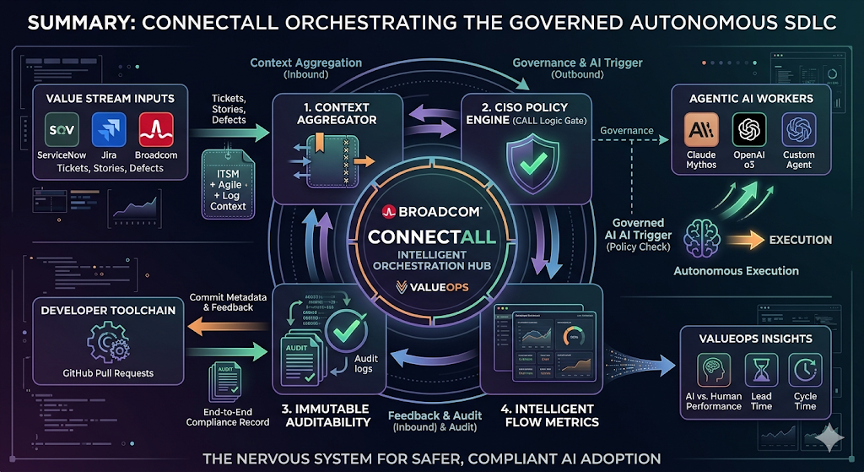
How does intelligent orchestration help scale the management of agentic AI? ConnectALL sits above the fray of individual tools, acting as the intelligent router, context aggregator, and compliance firewall for the entire software delivery pipeline. In the following sections, we detail the four key capabilities the solution provides.
1. The context aggregator
Before an AI agent is ever invoked, ConnectALL works in the background. When a critical incident hits ServiceNow, ConnectALL translates it, normalizes it, and creates the corresponding defect in Jira or Rally.
When it is time to trigger the AI worker, ConnectALL does not send a fragmented payload. It stitches together the entire lineage of the issue. It constructs a rich, comprehensive payload that includes ITSM data (such as information from ServiceNow), Agile metadata (from tools like Rally and Jira), source code repository links (such as GitHub), and attached log files. By provisioning AI with perfect, unified context, ConnectALL dramatically increases the agent's SWE-bench resolution rate and eliminates errors associated with blind spots.
2. The ConnectALL Logic Gate Adapter: The compliance policy engine
ConnectALL features Logic Gate Adapter, a centralized policy engine that sits between the enterprise toolchain and external AI models. (See figure below.)

Before ConnectALL fires a webhook to trigger an agent, the Logic Gate Adapter evaluates the request against global enterprise policies. CISOs can configure these types of explicit rules:
-
“Only trigger autonomous code generation if the Jira priority is critical, the component is NOT tagged ‘Financial Core,’ and the current system state is outside of a code-freeze window.”
-
“Require a mandatory, human-in-the-loop review for all AI-generated pull requests targeting tier 1 microservices.”
Because ConnectALL integrates with dozens of industry-leading tools, it can evaluate conditions across the entire ecosystem before allowing AI to execute. It ensures that autonomous agents operate strictly within the guardrails of enterprise leadership’s risk tolerance.
3. Immutable auditability and traceability
"You cannot audit an API call, but you can audit a value stream."
Every time ConnectALL orchestrates an AI workflow, it creates an immutable, timestamped record of the event. When the Claude Mythos agent submits a pull request in GitHub, ConnectALL's GitHub adapter detects the commit. ConnectALL immediately links that pull request back to the originating Jira defect and the root ServiceNow incident, tagging the commit as "AI generated."
If an auditor demands to know the origin of a specific code change, teams can produce a pristine ConnectALL audit log that features these details:
-
The exact ServiceNow incident that necessitated the change.
-
The ConnectALL Logic Gate Adapter rules that approved the AI trigger.
-
The exact payload sent to the AI model.
-
The GitHub pull request generated by AI.
-
The engineering lead who reviewed and approved the merge.
ConnectALL enforces separation of duties by ensuring that the AI agent remains an isolated execution worker, while orchestration and governance remain firmly under the control of the centralized governance platform.
4. Intelligent AI delivery metrics
Because ConnectALL acts as the central nervous system, it uniquely possesses the data required to measure the ROI of AI investments.
ConnectALL tags and isolates AI-driven workflows. Using ValueOps Insights by Broadcom, engineering leadership can finally answer the question: “How much faster are our AI agents compared to our human teams?” The Insights solution provides distinct flow metrics, such as lead time, cycle time, and flow efficiency. These metrics enable teams to compare AI-orchestrated value streams with traditional human-led value streams. This allows CIOs to quantify the financial impact of their AI models and identify the new bottlenecks in the system. For example, a team leader may discover that while AI writes code in five minutes, the human security review still takes five days.
Part 4: Summarizing the strategic imperative for the enterprise
The transition to agentic AI is inevitable. The competitive advantage of autonomous bug resolution and rapid feature development is simply too vast for any modern enterprise to ignore. However, history has shown that adopting transformative technology without proper governance leads to catastrophic technical debt and unacceptable security risks.
The enterprises that will win this decade are not the ones that simply plug the smartest AI into their Jira instance. The winners will be the enterprises that build a robust, governed, and orchestrated data pipeline capable of managing AI agents at scale.
ConnectALL provides a complete foundation that offers these clear benefits:
-
Risk mitigation: Ensure total compliance with SOC 2, ISO 27001, and DORA by maintaining immutable audit trails and strictly enforcing human-in-the-loop approvals when necessary.
-
Unparalleled AI performance: Feed agents the rich, cross-tool context they need to achieve state-of-the-art resolution rates.
-
Architectural agility: Utilize a hub-and-spoke model that allows the enterprise to effortlessly swap out underlying AI models (from Claude to Gemini to OpenAI), without rebuilding hundreds of brittle point-to-point automations.
-
Proven ROI: Measure the exact business value of AI through dedicated, tagged flow metrics.
As AI models approach perfect scores on engineering benchmarks, the value shifts from code creation to system orchestration. ConnectALL is the critical layer that transforms the chaos of autonomous agents into a secure, predictable, and hyper-efficient enterprise value stream.
Get started today
Visit the ValueOps ConnectALL page and find out how you can get ready for the era of intelligent software delivery orchestration.
Frequently asked questions
Q: What is the main difference between copilots and agentic AI?
A: Copilots are evolutionary tools that assist and speed up human developers, for example, by suggesting code. On the other hand, agentic AI represents autonomous digital workers capable of investigating and resolving complex software issues, without human intervention.
Q: What are the three critical challenges agentic AI poses to enterprise compliance?
A: The challenges are the visibilty gaps posed by an AI context gap, the creation of unmanageable point-to-point integration "spaghetti," and a breakdown in traceability and auditability for CISOs.
Q: How does ConnectALL ensure compliance and auditability in an AI-driven value stream?
A: ConnectALL enforces separation of duties and compliance by acting as a logic gate to evaluate policies. In addition, the solution aggregates complete business context for agents and creates immutable audit logs that link AI commits back to the originating ticket.
Q: How can regulatory frameworks be affected by decentralized AI automations?
A: Regulatory frameworks such as SOC 2, ISO 27001, and the EU's Digital Operational Resilience Act (DORA) require strict control and auditability over software delivery. Point-to-point integrations are ill-equipped to support these requirements in agentic AI environments.