

|
Note: This post was co-authored by William Karlin |
We view AI as a turbocharger. However, if you bolt a turbocharger onto a car with a flat tire (broken testing) or no steering wheel (poor strategic alignment), you won't win the race—you’ll just crash faster. To justify the investment in expensive AI tools, leaders must move beyond vanity metrics and measure the flow of value.
In the rush to augment delivery teams with AI, it’s easy to fall into the trap of measuring success by lines of code and tickets closed—in effect building a “feature factory.” However, we know that an increase in code volume does not inherently equal more value. If AI allows developers to write code 50% faster, but that work sits stagnant for three days in a pull request (PR) review queue—the process where teammates review code before it is merged—time to market won’t be improved by a single minute.
How can you tell if AI is creating value or compounding existing bottlenecks? Here are some thoughts on how to use Rally, Clarity, ConnectALL, and ValueOps Insights to build a rigorous measurement framework that separates hype from reality.
1. The execution engine (Rally)
Rally is the execution engine; it is where the rubber meets the road. To measure AI impact, you must look past simple velocity and inspect cycle time breakdown and quality.
The metric: Cycle time breakdown
AI coding assistants primarily reduce the time spent in “active development” states. AI-enabled teams often will see a 20% to 40% drop in these states.
However, the trap lies in what happens next. AI often shifts the bottleneck from writing to reviewing because AI-generated code can be verbose or subtly buggy, requiring intense human scrutiny.
- The test: Use the Cycle Time / Lead Time Chart in Rally.
- The indicator: If time in an active development state drops but another state, such as “Peer Review” or “Ready for Acceptance” spikes, then your process is bottlenecked. AI has accelerated the writing, but your reviewing process needs to be optimized to support this volume.
The metric: Defect density (the AI tax)
Speed without guardrails creates technical debt. Our analysis suggests that while AI coding assistants reduce time in active development states, they frequently spike peer review times and defect density. This is an “AI tax”—requiring teams to spend time fixing generated defects, which eats up your efficiency gains.
- The strategy: Track the number of defects linked to work from AI-enabled teams. If defect density rises alongside velocity, that may mean teams are shipping technical debt faster, eroding the value realized.
2. The strategic guardrails (Clarity)
While Rally measures the team, Clarity measures the business. With Clarity, you answer the strategic question: “Are we building the right things faster, or are we just wasting budget more efficiently?”
The problem: Misaligned capital allocations
AI might make a team 20% more efficient, but if that team continues to consume budget and do work that does not further company strategy, you haven't gained anything. You have simply reached the wrong destination sooner.
- The test: Use Clarity’s Strategic Investment Objects to map every AI-accelerated epic to a funded initiative.
- The pivot: As AI tool adoption increases, look for a reduction in hours allocated to “maintenance” and “sustainment.” If the percentage of capacity allocated to keeping the lights on (KTLO) doesn't decrease, you aren't harvesting the gains. You are simply letting the same amount of “run” work expand to fill the available time.
The financial hook: Frictionless Cost Accounting
Your CFO doesn't care about “story points.” They care about capitalized labor and the ROI of your Copilot licenses.
AI blurs the lines between CapEx (new features) and OpEx (maintenance).
- The solution: Use Clarity to automate Frictionless Cost Accounting. By ingesting signals directly from the work, Clarity can classify AI-generated output for capitalization without forcing developers to fill out manual timesheets. This provides the auditability required to defend your AI budget to the CFO.
3. The connectivity layer (ConnectALL)
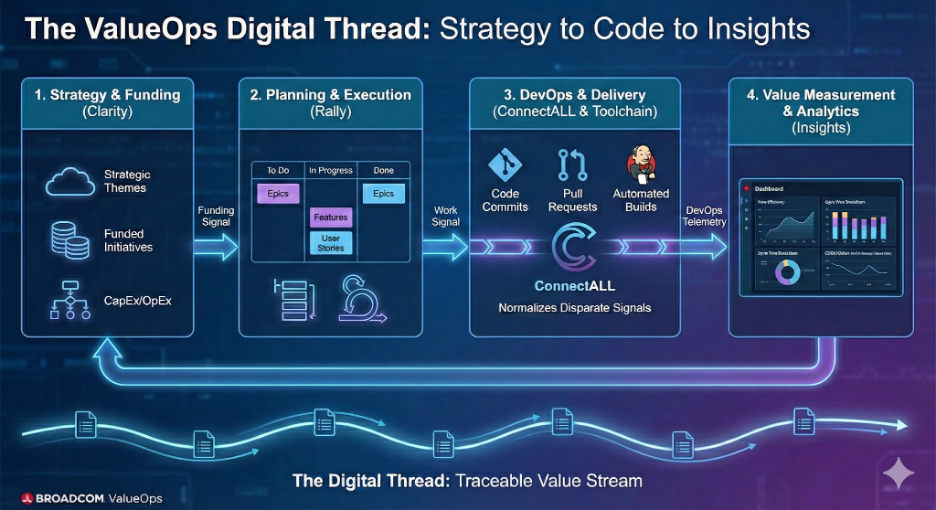
While Rally tracks execution and Clarity tracks funding of work, the actual delivery of value happens in the DevOps toolchain—in source control and continuous integration/continuous deployment (CI/CD) pipelines. To accurately measure the impact of AI, we need “on-the-ground truth” that is harvested directly from the systems in which code is written and deployed.
The missing link: From code to context
We often see a disconnect between the User Story in Rally and the actual code changes in tools like GitHub or GitLab. ValueOps ConnectALL bridges this gap by creating a "digital thread" that links code commits, PRs, and build status back to the original work item.
Crucially, ConnectALL normalizes these disparate signals. The solution translates the chaos of different tool terminologies into a common language, ensuring the metrics you see in ValueOps Insights are apples-to-apples comparisons.
The metric: The true cost of review
AI helps teams write code faster, which can potentially clog the review process. By ingesting data directly from source control, ConnectALL allows teams to measure:
- PR review duration: Exactly how long code sits waiting for human review.
- Iteration count: How many times a PR is rejected and reworked.
- Stall points: Highlighting exactly where AI-generated code is getting stuck.
The strategy: Automated CI/CD feedback
Speed is irrelevant if the build breaks. ConnectALL harvests results from automated pipelines (like Jenkins or Azure DevOps) to correlate build failures with specific AI-generated code changes. This creates an immediate feedback loop, allowing you to validate that increased velocity is not coming at the expense of stability. In addition, this provides the auditability required to trust your DORA metrics.
4. The unifying truth (ValueOps Insights)
ValueOps Insights consumes data from Rally, Clarity, and ConnectALL to provide a normalized view of your system's health. It promotes trust from leadership by giving everyone visibility into the things that affect value delivery.
The efficiency paradox: Why faster coding can slow delivery
Flow Efficiency is the ratio of Active Time (coding) to Total Time (waiting + coding).
Flow Efficiency = Active Work Time / Total Cycle Time X 100
- The AI impact: AI drastically reduces Active Time, which creates a stark contrast against your “Wait” time. It doesn't just lower your efficiency score; it shines a spotlight on exactly how much time your work spends sitting idle in queues.
- The goal: If Flow Efficiency is currently below 15% (a common industry benchmark), your immediate gain from AI won't be faster coding—it will be using AI to remove administrative wait time (like summarizing requirements or automatically generating test data).
The sanity check: DORA metrics
Broadcom ValueOps Insights offers out-of-the-box support for DORA metrics.
- Incident to Deployment Rate (Change Failure Rate): This is your critical guardrail. If this spikes, AI is hurting quality.
- Mean Time to Restore (MTTR): AI excels here. Case studies like this one from Meta indicate that organizations typically see MTTR reductions between 30% and 70% after implementing AI-based observability or AIOps.
Operationalizing the metrics: The 30-day bottleneck analysis
If you are ready to move from “hype” to “proof,” here is a pilot methodology that you can apply:
Phase 1: The baseline (week 1). Do not change anything. Open ValueOps Insights and note the three-month rolling average for Flow Time, Flow Efficiency, and Incident to Deployment Rate.
Phase 2: The pilot (weeks 2-3). Select two comparable teams. Give team A the AI tools; leave team B as the control group. Simply filter any reporting by “team A” (AI-enabled) versus “team B” (control). No manual tagging of stories required.
Phase 3: The analysis (week 4). Check the Cycle Time Breakdown in Rally.
- Coding phase: Team A should be significantly faster.
- Review phase: Check if team A is stalling here.
- Misalignment check: Go to Clarity. If team A has 20% spare capacity, immediately identify which strategic initiative to reallocate that capacity to.
Conclusion: From hype to enterprise value
Ultimately, measuring the impact of AI is not about developer surveillance; it is about mastering the physics of your software delivery factory. AI serves as a diagnostic mirror, instantly reflecting structural inefficiencies in your review cycles, testing protocols, and strategic alignment.
Your next strategic move: Log into Broadcom ValueOps Insights and inspect the “Flow Efficiency” metric.
- The insight: If this indicator is low (say below 15%), your organization’s highest ROI lever is not purchasing more AI seats, but re-engineering the “wait states” that currently trap value.
- The result: Fixing these bottlenecks ensures that your faster coding actually results in faster time to market, rather than simply creating a backlog of unverified assets.
The AI-adoption mandate is to ensure that accelerated coding translates into accelerated value. By leveraging Rally to optimize throughput, ValueOps Insights to monitor systemic health, Clarity to align capital allocation, and ConnectALL to tie in the rest of the systems supporting your value streams, you can empirically prove how AI investments convert technical output into business outcomes.
Please contact us to continue the conversation and watch a demo.